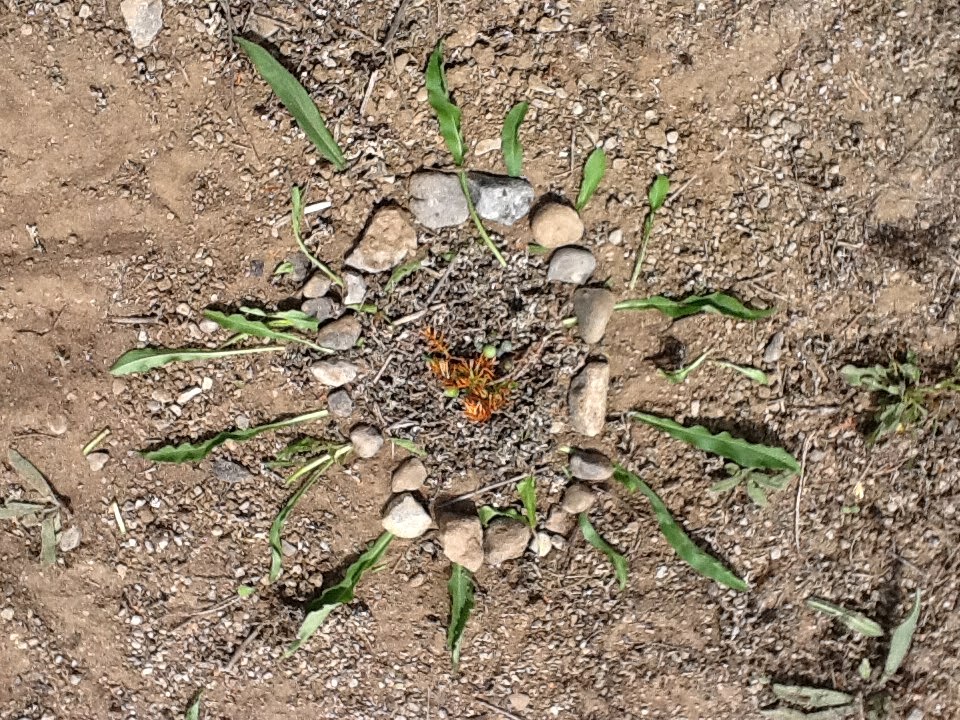
Our building center incorporates many natural materials. Simply by bringing outside materials in and inside materials out, items are seen differently and new thinking and interest emerges.
Some pictures of our creations:
A.A's cat house
H.M's train track with tunnel
T.W's tower. T.W: "It's 9 logs tall. It's taller than me!"
T.M, J.T, C.W's cave.
This cave turned out to be a great lesson in perseverance and problem-solving. When they first tried to build it, they used smaller blocks for the walls. They said they wanted to add a roof, but didn't know how because it was too low. They discussed it and ended up taking down their original sides, adding bigger blocks first, and building the sides higher. Then they got stumped on how to build the roof. After some discussion they were still stuck on what to use so we brought it to the group. Suggestions included laying the longer blocks across the top, laying pieces of our greenery and pine boughs across the top, or using a blanket as the roof. They chose the blanket. Then they ran into the problem of the blanket sliding down and sagging into the middle. To solve this they pulled it tight and put blocks on top. Finally they had some stability issues with the sides where the blocks narrowed and were tippy. They added blocks to either side as supports.
We have also incorporated natural elements into our sand area.
Our math center contains a class set of bins with various open ended materials in them such as rocks, corks, beads, bottle caps, shells, pasta, pom-poms, etc. We also put our five and ten frames, egg cartons, and sorting hoops to go along with the materials
These items can be used in a number of different ways from counting, to sorting, to patterning, to comparing. The children love exploring the bins and before long the math emerges!
R.H and J.T
L.F and R.F
Sometimes the math bins get used for other things, and that's o.k too! H.M and S.B decided to make race tracks using the materials one day. They wrote about their tracks as well.
H.M: "I made a race track. Cars race on it. It has a trophy. The cars have to collect diamonds. Whoever gets to the finish first gets the trophy. It has animals to watch the race. There's water that you have to jump over. The crowd cheers."
S.B: "I made a race track. It has a crowd. It has racers. It has a finish line. It has jewels. It has hot spots. The crowd is bears. The blue is water. The red is lava. The yellow is fire. The racers collect jewels."
L.F at the water table engaging in some measurement.
And sharing with the class what she discovered. L.F: "Adding water to the sponges makes them heavier."
Mrs. Bell and I debated getting rid of our colourful carpet at our meeting place. We discussed how it just didn't go with the calm, neutral feel we wanted in the classroom. Just when we thought we had made up our minds to get rid of it....
We were doing our question of the day and counting by 5's on the five frames, when L.F. came out with "Hey our carpet has five frames!". We quickly cleared off the carpet so that she could show us her thinking.
S.B then said, "Well two five frames make a ten frame so our carpet also has ten frames on it."
We set up a Take Apart center with old appliances and electronics, safety goggles, and real tools. This center was a hit!! Great fine motor practice done in a motivating way!
R.M and V.J dismantle the toaster
We take alot of pictures in kindergarten and often we end up with duplicates or ones we don't use. We added these pictures to the writing center, thinking that maybe some children would like to write about them. We had no idea how motivating these pictures would be. We had several student using multiple pictures and then attaching them all together to make class books. They are on display in our reading nook and are continually read by the children.
E.M is writing her classroom book. She has taken her friends' names off of the class word wall to spell them correctly. Our word wall is the back of a shelf that we painted using magnetic blackboard paint. That way all words are easily accessible and easily removable.
We have a read aloud followed by independent reading every day. We have had many discussions about what good readers do. We talked about how one of the things they do is stay focused when reading, but that this is difficult to do right off the bat so we have to increase our reading stamina slowly. For many weeks we worked on becoming better and better independent readers. When we finally reached our goal of 15 minutes we were so excited and proud. It was obviously a big moment, when one student chose to write about our reading stamina in her journal.